本文へスキップ

Beyond Nohgaku · English · Oni

Oni are not demons —
and Demon Slayer
knows it.

Why Japan’s oni are not demons, what Noh has staged for six centuries, and where to find them on your next trip.

↳ Tap the label to take it off.

/o·ni/

oni — often a person, pushed outside

Jo — the opening
A word, and what it hides

1 / 8

The word on the title

The English title is Demon Slayer. The Japanese word behind “demon” is — oni.

In the story, Tanjirō’s sister Nezuko is not killed. She is turned. Viz’s description of the first volume says it directly: she has been “turned into a demon herself,” and Tanjirō sets out to return her to normal. You cannot return a Western demon to normal. A demon was never anything else.

In shortThe series itself shows that oni are not demons. Noh, a theatre centuries older than anime, has been showing it too.

2 / 8

A word English does not have

Fans often compare the series’ oni to vampires, and the comparison is not baseless: they feed on humans, sunlight destroys them, and wisteria does roughly the job garlic does. A 2024 research note by Noriko T. Reider in Japan Review takes this seriously. She argues that the series’ oni keep traditional traits, such as eating people and changing shape, and add Western ones, “most notably vampires.”

What the vampire comparison leaves out is more interesting. In the series, demons are former humans, made by Muzan’s blood. And in older Japanese thought, an oni was not even a body. In early Onmyōdō, the word meant an invisible spirit that caused illness. Another strand, kokoro no oni, “the oni in the heart,” was a dark disposition of the mind given a shape.

In short“Demon” hides that an oni is often a person, and often a person pushed outside.

Ha — the breaking open
What Noh puts on stage

3 / 8

Named, not born

Reider cites the folklorist Komatsu Kazuhiko: people with “different customs,” or who lived beyond the reach of the emperor’s control, could be called oni. The Nihon shoki uses the character for those who opposed the throne. Noh keeps both sides of this.

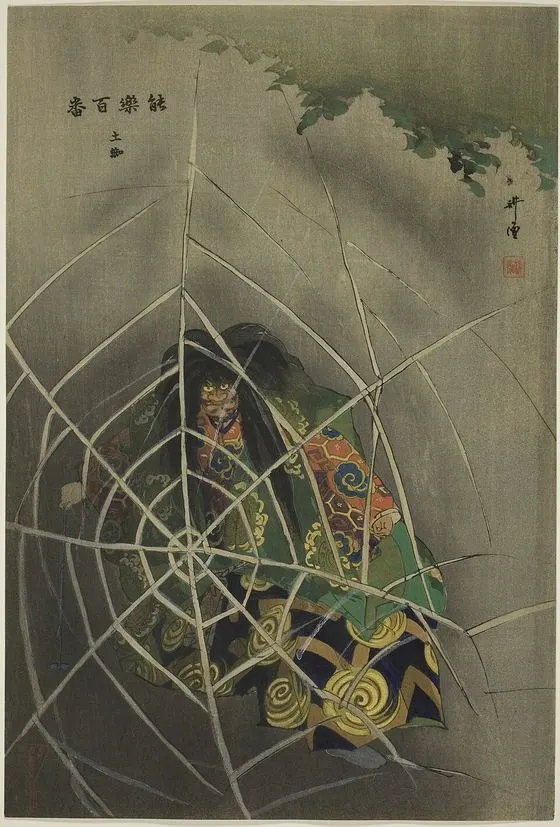
Kōgyo print of Tsuchigumo: the spider spirit caught in a web of thread
TSUCHIGUMO

A being outside the order is given a monstrous face and killed.

Called monstrous
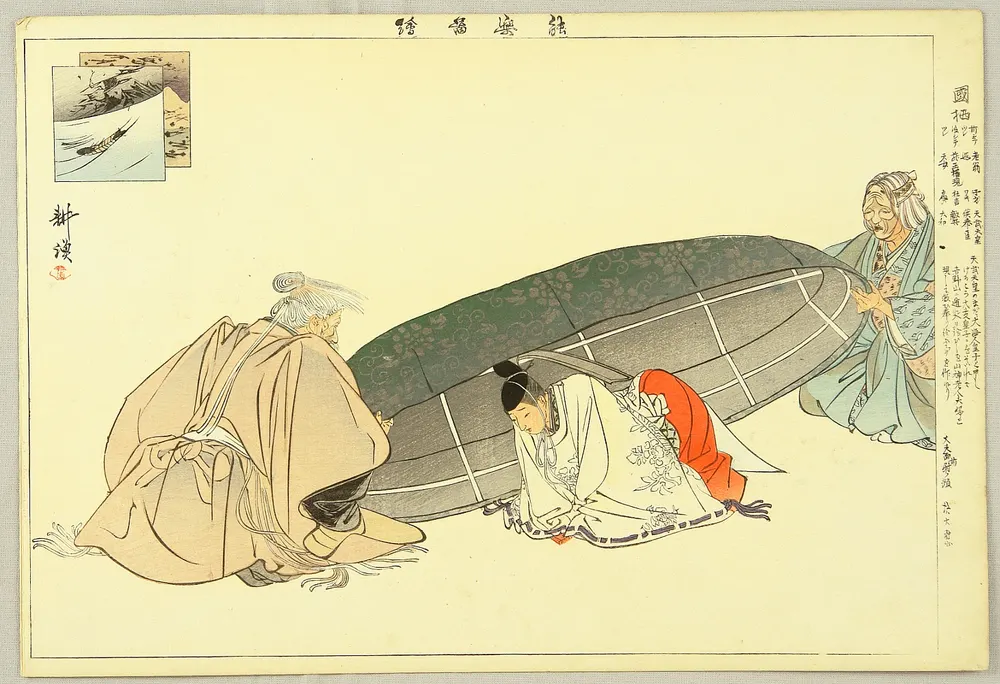
Kōgyo print of Kuzu: an old couple hide the emperor under an overturned boat
KUZU

Also from the mountains beyond the center, but here they shelter an emperor, and no one calls them oni.

Never called oni

Being outside does not make an oni. Who does the naming, and how much voice they allow, does.

4 / 8

Made from within

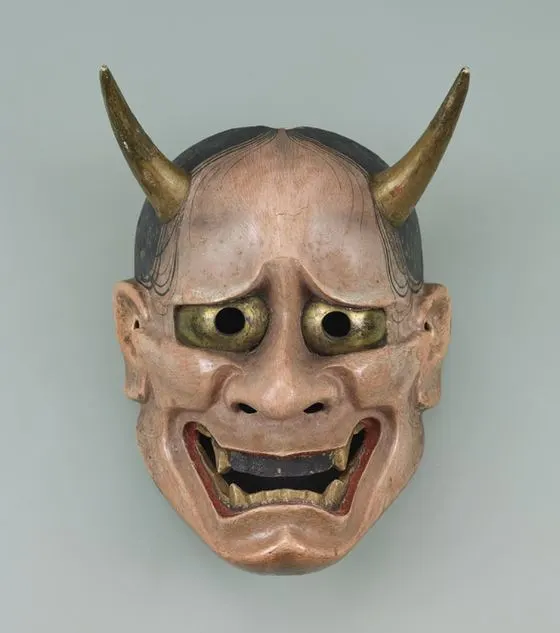
In shortA hannya mask does not make a character an oni by species. The story, the image on stage, and later classification are three different things.
Hannya Noh mask, Edo period, Tokyo National Museum
Hannya mask, Edo period (17th–18th c.). Tokyo National Museum, C-1554.

5 / 8

Not every strange thing in Noh is homegrown

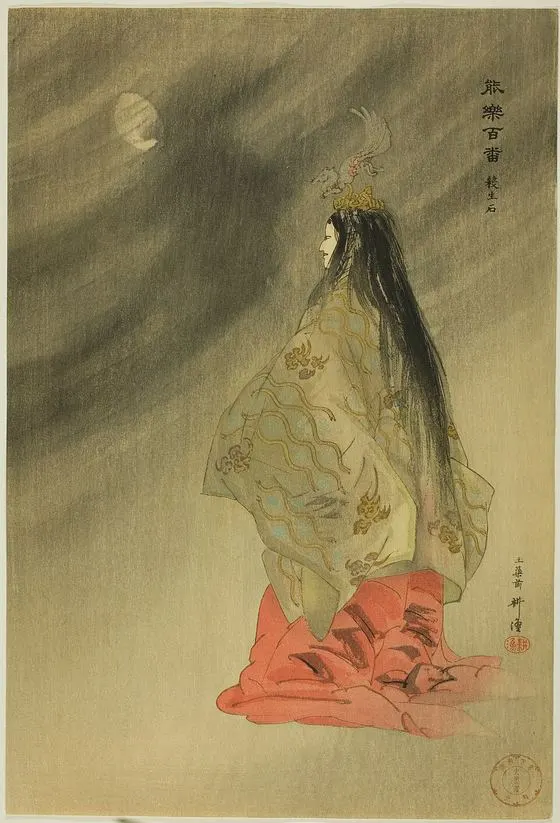
Sesshōseki is not about an oni at all. A fox spirit, bound to a stone in Nasu, hears the priest Gen’nō’s prayers and vows to stop her harm. Noh stages repentance, not slaying.

The famous version is bigger: a fox that crosses India, China and Japan in turn. That grander journey is a later layer, joined onto the stone. It does not make the idea less interesting. It asks why a story about a stone became a story about a continent.

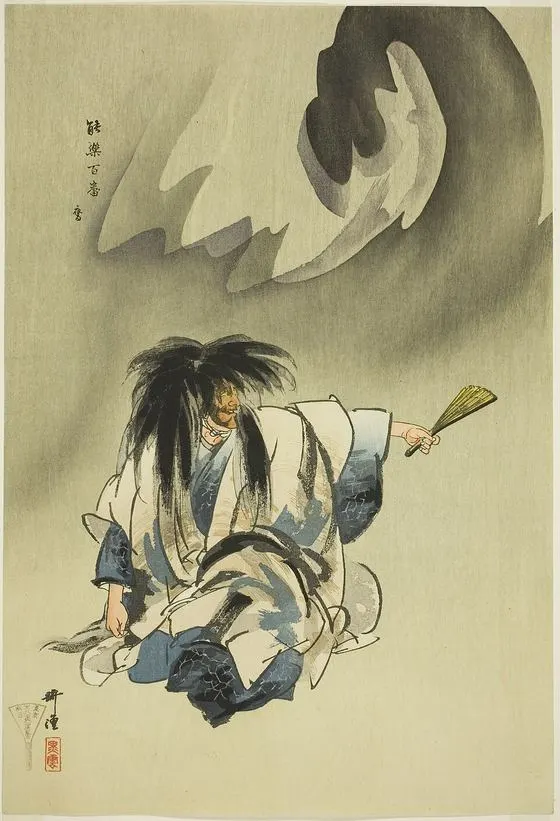
Kōgyo print from the Noh play Sesshōseki
Sesshōseki, from Nōgaku hyakuban, Tsukioka Kōgyo.

TALES · ENDINGS

Who decides how it ends?

Each tale is a Noh play, told as a story first. Read them as you would Interview with the Vampire: a creature with its own logic, and a human who has to listen to it. The comparison is ours, and it claims no influence. The question is: How does a being with its own logic see us — and who gets to tell its story?

Six plays, six endings. In four the being is held back or killed without being asked. In two it ends the story itself. Tap a play to read its tale.

Kyū — the swift close
The words, and who holds them

6 / 8

What Japanese calls these

oni

Often a person made monstrous, or placed outside.

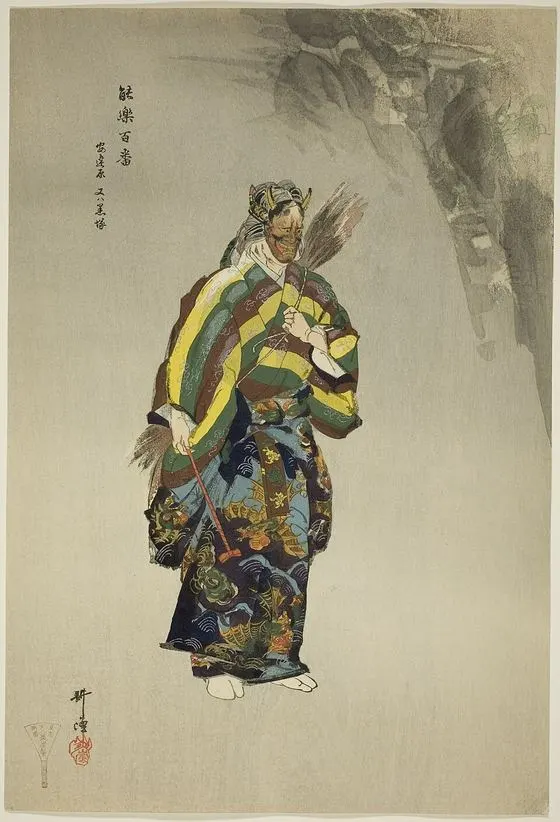
Noh: Adachigahara, Kanawa
onryō

A dead person who returns with a grievance.

Noh: Funa Benkei (Tomomori)
ikiryō

The spirit of a living person.

Noh: Aoi no Ue
henge

A being that changes shape: fox, serpent.

Noh: Dōjōji, Sesshōseki
tsuchigumo

A name for those outside the order, later made monstrous.

Noh: Tsuchigumo

7 / 8

Who names whom a demon?

The question is rarely about horns. It is about position: who is allowed to speak, and who is only spoken about. In the series, even oni with sympathetic pasts are still defeated, Reider notes. Noh is less consistent: some are slain, some pacified, some given a voice. The difference is not in the creature. It is in the telling.

8 / 8 · AFTERWORD · WHERE TO GO NEXT

The older story, one layer down

If you are already heading to these places, here is the story underneath. Each is an addition for the curious, not a reason to travel on its own.

Togakushi ShrineNagano
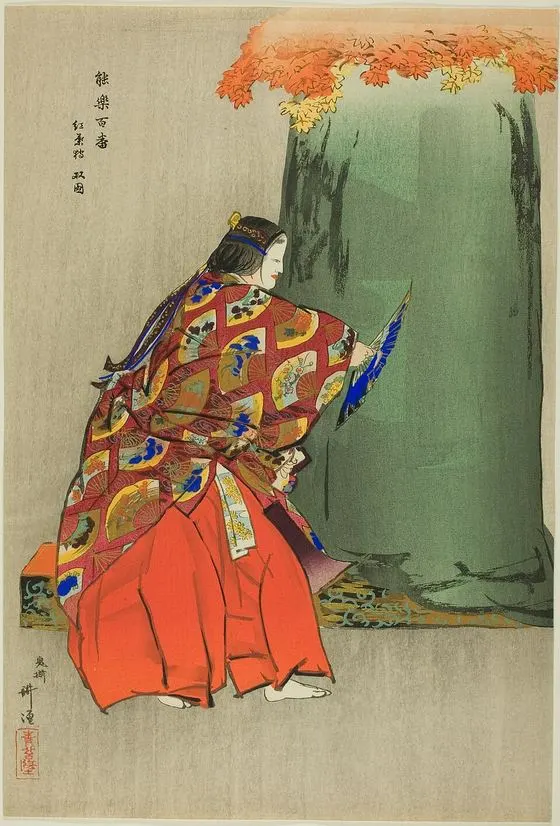
Kōgyo print of Momijigari: the noblewoman beneath autumn maples
Momijigari, Kōgyo.
Autumn play · September

Momiji, the woman who is an oni

In Togakushi she is the demoness slain by the warrior Koremochi. In neighboring Kinasa she is remembered as a noble woman who taught sewing and silkworm rearing. At Daishōji Temple her memorial tablet is shared with Koremochi’s, and the temple holds scrolls painted with scenes from the story. Higher on Mount Arakura, the campground has a Noh stage, and a cave where she is said to have lived lies about an hour’s walk beyond it.

Momijigari in the database (Japanese) →
Nasu hot springsTochigi
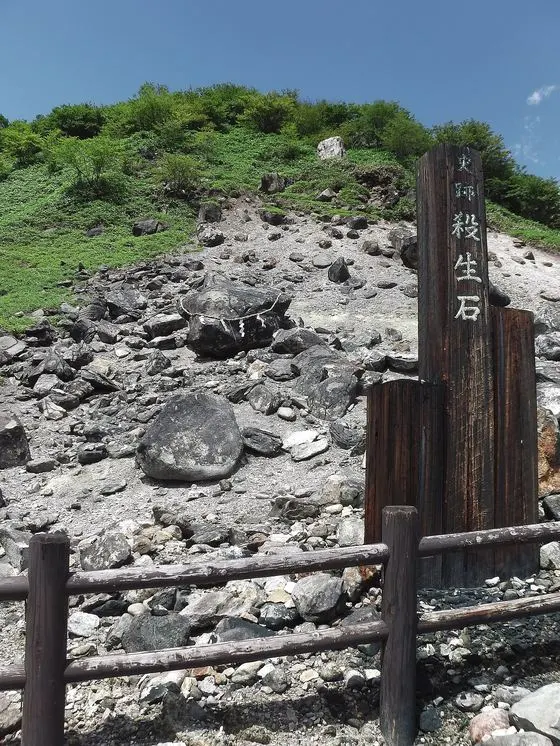
The Sesshōseki stone field at Nasu with its wooden marker
The stone field at Nasu, 2016.
Autumn play · September

The Killing Stone, and the fox inside it

The Sesshōseki stone is a nationally designated Place of Scenic Beauty. Noh stages it as a fox spirit bound to the stone, who vows to stop her harm after the priest Gen’nō prays for her. A famous later version has the fox cross India, China and Japan; that is a different layer from the Noh play.

Sesshōseki in the database (Japanese) →
AmanohashidateKyoto (north)
Season not recorded

Mount Ōe and the Oni Exchange Museum

South of Amanohashidate, Mount Ōe is known for the legend of Shuten dōji. At its foot, a museum is devoted to oni legends and masks.

Ōeyama in the database (Japanese) →
Byōdō-inKyoto (Uji)
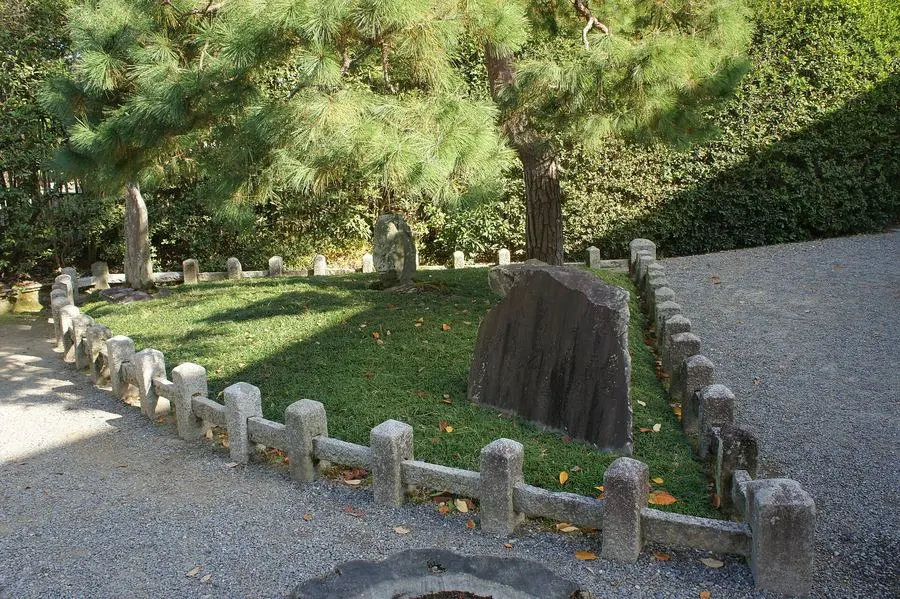
Byōdō-in temple grounds, Uji
Byōdō-in, Uji.
Season not recorded

Yorimasa’s last stand, and the fan-shaped lawn

Yorimasa, the archer who shot the nue, was defeated in the Battle of Uji in 1180 and is said to have taken his own life in the grounds of Byōdō-in. The small lawn is called Ōgi-no-shiba, the fan lawn: tradition says he laid a fan facing west before he died. His grave is in the grounds, and each year on the anniversary, May 26, monks recite sutras there.

Nue in the database (Japanese) →
The Kii PeninsulaWakayama
Spring play · March

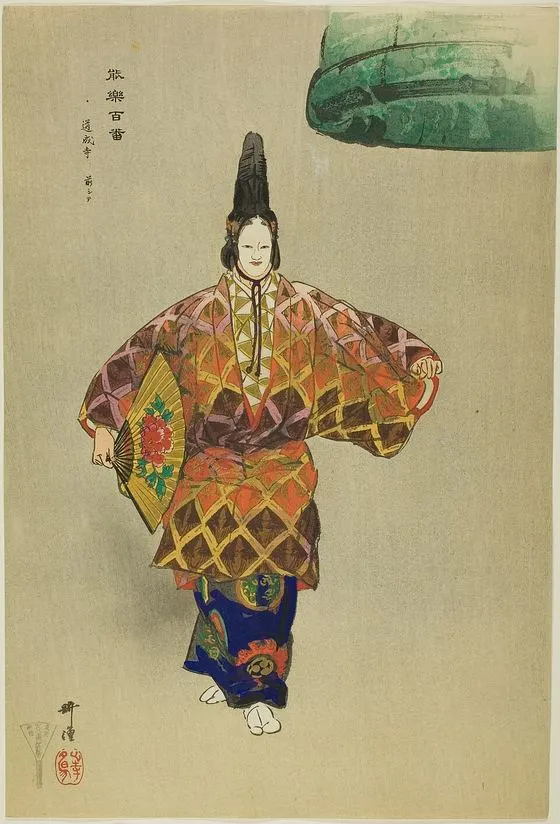
Dōjōji and the serpent in the bell

At Dōjōji, the story of the woman who became a serpent is told with a picture scroll, and a bell memorial is held each year on April 27.

Dōjōji in the database (Japanese) →
Visit respectfullyMany of these are living temples and shrines. Check opening times, and ask before entering. Plays are traditionally associated with a season; for what is on stage now, see the Japanese performance listings.
Updates plannedMore places will be added: the Kurozuka mound in Fukushima, tied to Adachigahara, among them. Details, access and seasonal events will be filled in as they are confirmed.
Further reading. Reider, N. T., “Demon Slayer Kimetsu no yaiba: Oni, Vampires, and Sexuality,” Japan Review 39 (2024): 203–219. doi.org/10.69307/japanreview.39.0_203. Viz Media’s product description of Demon Slayer: Kimetsu no Yaiba, vol. 1.
Picture credits. Noh prints: Tsukioka Kōgyo, Nōgaku hyakuban (One Hundred Noh Dramas), 1898–1903, Art Institute of Chicago, public domain, via Wikimedia Commons. Kuzu print: Tsukioka Kōgyo, via ukiyo-e.org (Artelino). Hannya mask: National Institutes for Cultural Heritage, “ColBase: Integrated Collections Database of the National Museums, Japan” (Tokyo National Museum, C-1554), CC BY 4.0, via Wikimedia Commons. Sesshōseki stone field: ウィキ太郎 (Wiki Taro), public domain, via Wikimedia Commons. Byōdō-in: 663highland, CC BY 2.5, via Wikimedia Commons. Photographs and the mask are resized and compressed for the web.