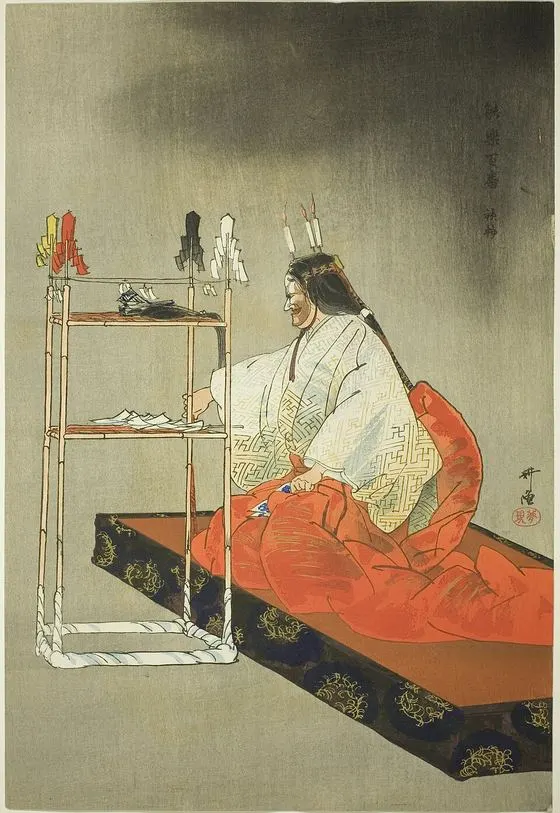
A woman abandoned by her husband is given instructions. She follows them.
1 / 3
The tale
A woman whose husband has left her goes to Kibune Shrine night after night. One night she is told how: put an iron trivet on her head, paint her face red, and keep her anger alive. If she holds it, she will become an oni.
Her husband begins to have terrible dreams and goes to the diviner Abe no Seimei. Seimei makes figures of the husband and his new wife and begins prayers.
The woman arrives as an oni and attacks the figures. The gods turn her back. She says that she will wait for another time to meet them, and for now she goes home.
2 / 3
Two sides of the telling
From its side
She is the one who turns herself into an oni, step by step, with a method. The anger was hers before the instructions came. The play shows it being given a shape she can carry.
From the human side
Seimei’s side is the diviner’s: read the sign, make the figures, pray. He treats the oni as something to be handled, not understood. She is sent away without being defeated, and she says she will return.
The question behind this seriesHow does a being with its own logic see us — and who gets to tell its story?
3 / 3
What Noh does with it
This is one of the clearest Noh examples of an oni who was a person a moment ago. The ending is a withdrawal. Her revenge is unfinished.
Compare with
In Interview with the Vampire, a creature tells a human interviewer how he became what he is. Noh arranged a similar meeting long ago: the waki asks or listens, the shite tells or shows. This comparison is ours, and it is not a claim of influence. The difference matters: here the listener has the power to send her away.