Frieren, Noh, and the long memory of Japan. An elf outlives everyone she loved, and keeps finding him anyway. Three ghost plays, a summer festival, and an old tree with a rope around it.
There is something unusual about Frieren: Beyond Journey’s End from its very first pages. The great adventure is already over. The Demon King has been defeated, the heroes have gone home, the celebration has finished. What would normally be the ending of a fantasy story is the beginning of this one.
Then time passes, and it does not pass at the same speed for everyone. The journey with Himmel had lasted ten years — an enormous piece of a human life, a short errand for an elf who has already lived more than a thousand. Fifty more years go by almost casually. Frieren looks much the same. Himmel does not.
And then Himmel dies.
A little after the funeral she goes to find Eisen, the warrior of the old party, who asks whether this is another journey to collect spells. Yes, she says, that too — and then, standing in the open with the mountains behind her: 「私はもっと人間を知ろうと思う」 — watashi wa motto ningen o shirō to omou, I think I’ll try to know humans better. That is the whole of it. His death is what sends her out again, now toward Aureole, the land where souls are said to rest, where she might speak with him once more.
That is what first drew me to this story. Not that it is about mortality — a great many stories are. It is that the meaning of a relationship goes on changing after one of the two people in it has died.
I live in Japan. The longer I follow Frieren’s second journey, the more it points at things that have always been around me here: graves, Obon, old trees with rope tied around them, names kept in temple registers, landscapes with stories attached, and Noh plays in which a traveller arrives somewhere and finds that the past has not entirely left. I do not think the series is a secret explanation of Japanese religion, and I have no wish to turn an elf out of European fantasy into an allegory for Shinto. It is something less definite and, to me, more interesting: a work made in the culture you live in can make you notice that culture differently.
盂蘭盆Urabon · the returning dead
2 / 10
Himmel’s death is not the end of their relationship
A common language of grief speaks of letting go, or moving on. There is truth in it — the living have to go on living. But it is not the only available shape.
Here a funeral is not necessarily the last point of contact. There may be a grave to return to. A household may keep a butsudan, a Buddhist family altar. Names of the dead may stay in family or temple records. And every summer there is Obon.
Dictionaries describe the observance as centred on the fifteenth day of the seventh month in the old calendar, held from the thirteenth to the sixteenth since the Edo period: a welcoming fire, mukaebi, is lit on the evening of the thirteenth to bring the spirits of the dead in, and a sending fire, okuribi, on the evening of the sixteenth to send them away again. Some regions keep the old calendar; many now hold it a month later, around 15 August. For a great many people today it is also simply the summer holiday — crowded trains, a few days off, a trip home.
The four days
盂蘭盆・迎え火と送り火
13迎え火A fire is lit to bring them in
14They are here
15They are here
16送り火A fire is lit to send them away
Dictionaries put the observance at the fifteenth day of the seventh month in the old calendar, held over these four days since the Edo period. Where it falls now depends on the region: some keep the old calendar, many hold it a month later, around 15 August.
What interests me is the shape of the movement, which survives even where the belief has gone quiet. Return. Remember. Depart again. Mourning here is not only the severing of a relationship. Sometimes it changes the relationship’s form. The dead are absent; they are not treated as though they had never been there.
That is what I recognise in Frieren. Her second journey does not gradually make Himmel smaller. It does the opposite. Years after his death she keeps discovering him — a remark she had barely registered, a decision she had not understood, a statue, a place, a promise, a ridiculous detour that decades later no longer looks ridiculous. He is dead, and her relationship with him is still moving.
3 / 10
A place remembers before she does — 井筒 Izutsu
This is where Noh comes in for me. One of the characteristic structures of mugen nō, dream Noh, is deceptively simple. A traveller arrives at a place — very often a Buddhist monk. He meets someone, and hears what happened there long ago. Only later does he understand that the person speaking belongs to that past. The dead return, frequently in a dream, and for a short while an event that has already ended is present again.
The shape it usually takes
夢幻能
1A traveller arrives somewhere.Most often a priest — and in 35 plays of this site’s database a travelling monk with no name and no temple.
2Someone of the place meets him — a villager, a woodcutter, a fisherwoman.
3He hears what happened here, long ago.The place is doing the remembering.
The interval中入
4The one who spoke returns, no longer disguised: the dead, often in a dream.
5For a short while, what had ended is present again — narrated, danced, suffered through.
6Dawn. The dream breaks, and the traveller walks on.
One characteristic shape, not a rule that every dream play obeys. In this site’s database, 30 of the 37 plays with a travelling monk are classed as two-act dream plays; Matsukaze, read in section five, is a one-act one.
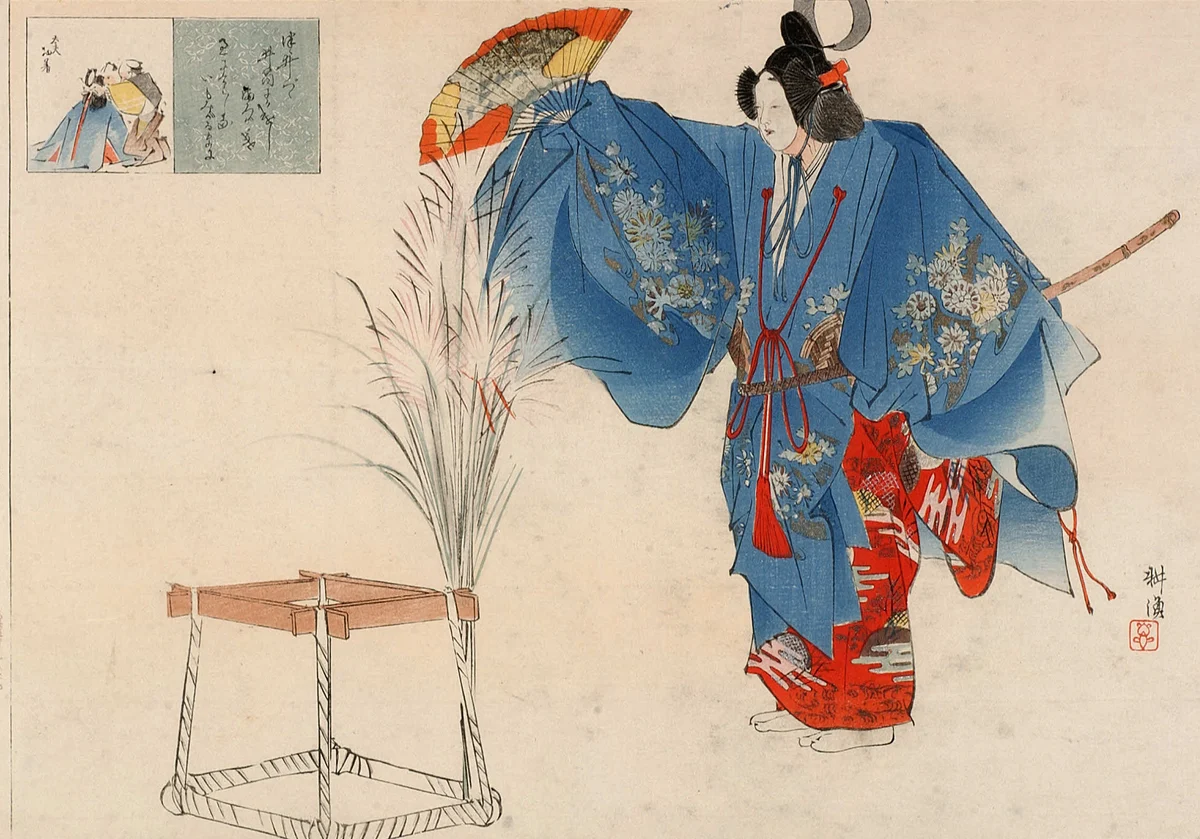
Zeami’s Izutsu is one of the most refined examples. A travelling monk reaches a temple associated with the poet Ariwara no Narihira. A woman appears and tells him about a man and a woman who had known each other since childhood; their memories are tied to an old well. As children they measured their heights against its curb — the episode comes from the Tales of Ise — and later they became lovers. Eventually she lets the monk understand that she is the dead woman of her own story. At night she appears again in his dream wearing the robe of the man she loved, and looks down into the water of the well, searching for his face. Then the dream breaks and it is morning.
Izutsu, from Nōgaku zue, Tsukioka Kōgyo. The woman wears the cap and hunting robe left by Narihira. Ritsumeikan University Art Research Center, arcUP0905, via ukiyo-e.org (public domain). Cropped to the printed image.
The lovers are gone. The well is still there.
That is what strikes me. Memory in Izutsu does not live only inside a human mind. It has attached itself to a place, and the place hands it back to whoever stops and asks.
Frieren rarely decides, in the abstract, that she will now think about Himmel. She encounters something. A town. A road. A statue. A flower. Someone says a sentence that echoes a conversation from decades earlier — and he is there again. She travels through a world that sometimes remembers before she does.
神木Shinboku · the sacred tree
4 / 10
What a thousand years sees in fifty
Frieren’s being an elf matters, and not because it makes her powerful. It changes the scale on which she experiences time. Ten years with Himmel seemed small to her. The next fifty passed almost without being noticed. For Himmel those fifty years were old age.
The same fifty years, on two clocks
同じ五十年・ふたつの尺度
Both bars are drawn to the same scale. The dark segment is the same fifty years on each.
Himmel a human life
Those fifty years were the rest of it: the end of the journey, old age, his death.
Frieren an elf
The same fifty years, then a life that runs off the edge of the page. The story gives no figure beyond “more than a thousand years”, and at this scale a thousand would need some two and a half more of these bars.
That difference in scale makes me think first not of another person but of a tree. Japan has many old trees that are treated as more than scenery. Reference works describe the shinboku, the sacred tree, as a tree held in reverence with a shimenawa rope strung around it — most often an evergreen, pine, cedar or cypress, and most often a big one. One encyclopedia notes that such trees are marked because of an old idea that a deity descends into a tree; another calls the tree a yorishiro, a thing a deity may be approached through.
I do not want to flatten this into “Japanese people worship trees.” That would be easy and inaccurate. What interests me is the feeling of scale. An old tree may have stood before our grandparents were born and may remain after we are gone. Several generations of births, quarrels, marriages and deaths can happen beneath it. On the tree’s timescale we are brief visitors.
Frieren is closer to that scale than we are, and at first it makes human time hard for her to read. Why hurry? Why ask now? Why make such a fuss about ten years? There will be another chance.
Until there is not. That may be the cruelty hidden inside her longevity: having more time does not teach her the value of someone else’s limited time. Himmel has to die first.
5 / 10
When the pine becomes the man — 松風 Matsukaze
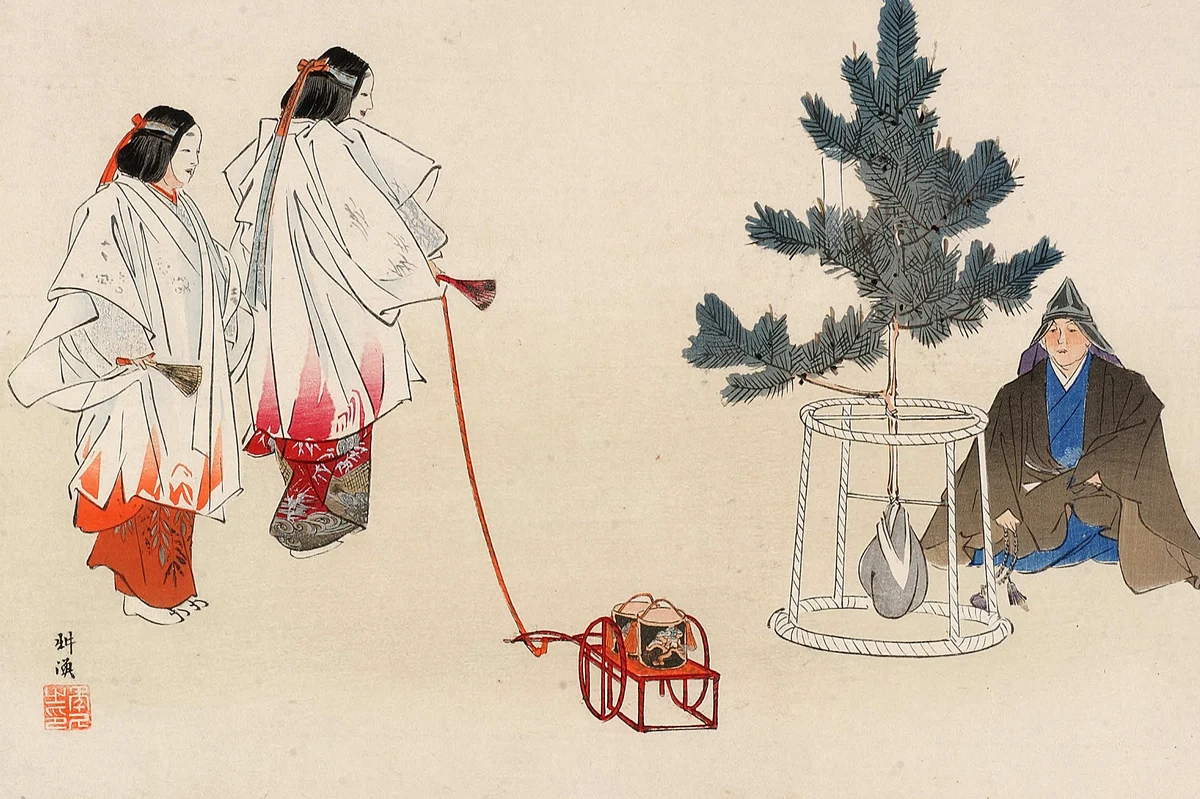
Among Noh plays, Matsukaze comes closest to this meeting of human memory and the longer life of a landscape. A travelling monk arrives at Suma Bay and notices a pine marked as the memorial of two dead sisters, Matsukaze and Murasame.
Matsukaze, from Nōgaku zue, Tsukioka Kōgyo. The sisters with the brine cart, and the pine hung with a sacred rope. Ritsumeikan University Art Research Center, arcUP0850, via ukiyo-e.org (public domain). Cropped to the printed image.
The man they loved was Ariwara no Yukihira (818–893), a poet and courtier, elder brother of Narihira, with poems in the Kokin and Gosen imperial anthologies and one in the Hundred Poets. It is worth watching how thin the ground under the legend is. A headnote in the Kokinshū says he shut himself away at Suma “in connection with an affair”; an encyclopedia remarks that the facts are unclear. What the play stands on is not an event but a chain of retellings.
What the play stands on
詞書から能まで・再話の連鎖
9th c.古今集の詞書
A headnote says Yukihira shut himself away at Suma “in connection with an affair”. An encyclopedia adds that the facts are unclear.
c. 1008源氏物語 須磨
Reference works take that exile story to lie behind the Suma chapters of the Tale of Genji, about a century later.
15th c.能『松風』
Four hundred years after that, the exile has become a story about two fisher-girls, and then this play.
later歌舞伎
The same material is taken up again on the kabuki stage.
In the play the sisters are long dead when the monk arrives. Their ghosts come to him; Matsukaze is undone by the keepsake robe, and in the climactic movement the pine stops being a pine. For her it is him. The man is gone. The woman remembering him is herself dead. The tree remains.
Then morning comes, the ghosts vanish, and what is left is the wind in the pines. Nothing is resolved. Nobody is released. The play ends in weather.
This is a very different kind of remembering from Frieren’s. Matsukaze stays inside her longing; Frieren’s memories slowly turn her toward the living. But the two share an image I cannot get rid of: human lives pass, and the world they lived in stays. Part of the melancholy of her journey is that she is one of the things that stay. A village changes and she remembers how it looked. A person becomes history and she remembers him simply standing next to her. Like the pine at Suma, she has become a witness on a scale larger than a human life.
6 / 10
The quiet accumulation
The series has battles, demons, formidable magic. Those are not the parts that stay with me longest. I remember meals. An unnecessary stop. A birthday. A gift that looks trivial. Someone sleeping too late. A conversation whose weight only becomes clear much later.
The people who voiced it said something close to this when the second season finished.
Atsumi Tanezakithe voice of Frieren
「第2期は、静かな時間の積み重ねと、息をのむようなアクションが同居していた印象です」
My impression is that an accumulation of quiet time and breathtaking action lived side by side.
It is because the bond deepened and the distance closed as the three of them travelled on that words that honest could finally come out.
That seems to me one of the central ideas of the work. A human life is not made only of major events. It is built out of things that look insignificant while they are happening. Frieren’s misfortune is that she often sees their significance late. Her gift is that she lives long enough to meet their meaning a second time.
7 / 10
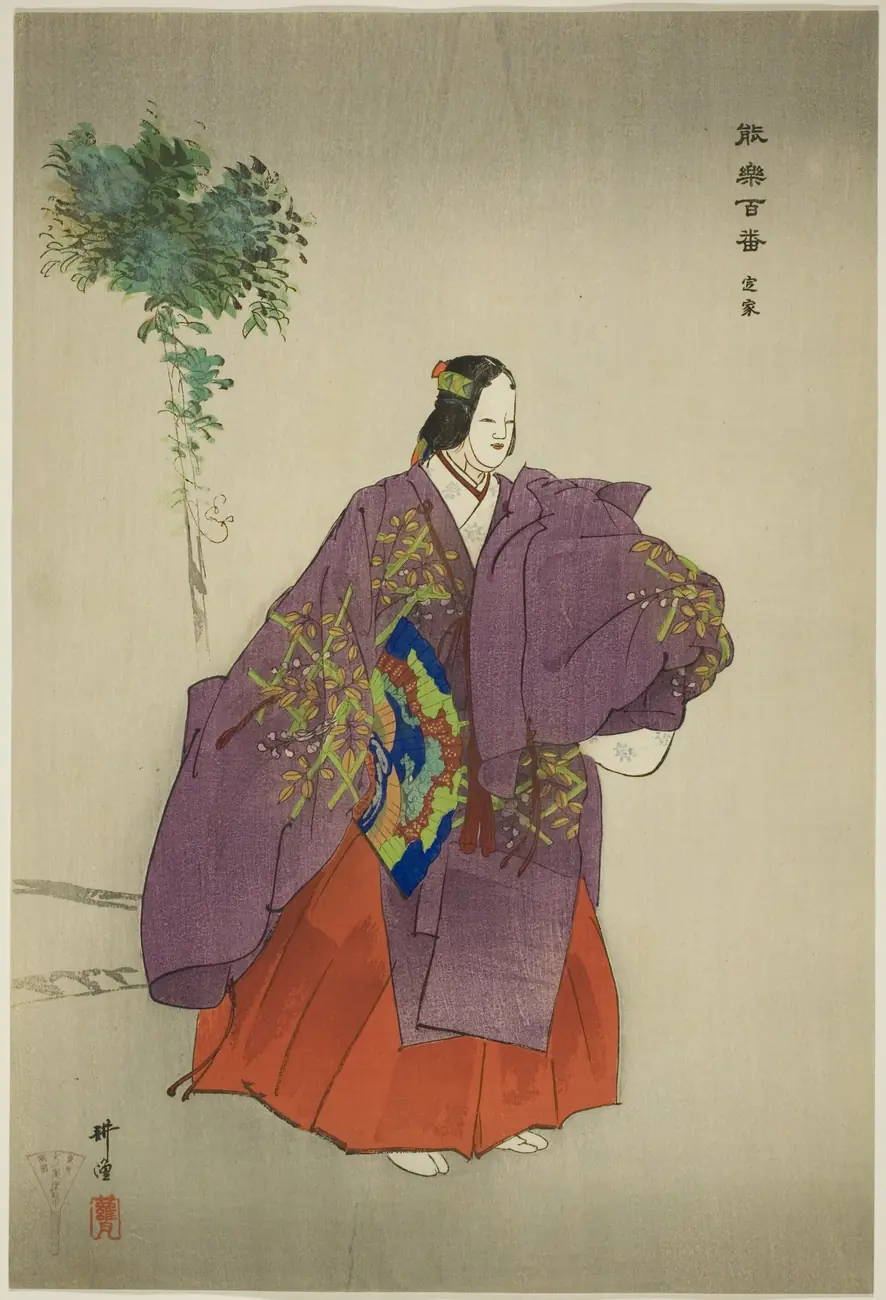
The vine on the grave — 定家 Teika
Teika, from Nōgaku hyakuban, Tsukioka Kōgyo. The ghost of Princess Shikishi. Art Institute of Chicago (public domain).
If Izutsu makes me think about place and Matsukaze about the long life of a landscape, Teika makes me think about the relationship itself. The play concerns the dead Princess Shikishi and the poet Fujiwara no Teika, and it gives his attachment an extraordinary physical form: teika-kazura, a climbing vine carrying his name, has wound itself over her grave. His obsession, clamped on her. The relationship has become landscape. It clings. It binds. It goes on after both of them are dead.
And here the play appears to do something Matsukaze refuses to do. The monk reads the sutra, the vine loosens, the princess comes out of the grave, and she dances in thanks.
Whether that is a release is where the accounts part company, and they do not part evenly. Two Japanese dictionaries say the merit of the sutra brings her to buddhahood. The Kanze line, whose staging this page takes as its baseline, reads it the other way, and two encyclopedias describe the same ending: the relief lasts a little while, she goes back into the grave, and the vine closes over it again. One of them calls the ending a dark one.
In a published conversation about the play, the scholar Matsuoka Shinpei puts that turn at its sharpest: she chose Teika’s obsession over buddhahood. The actor Kanze Kiyokazu, in the same conversation, recalls his father telling him to end the piece beautifully — a woman electing to go on suffering, and the election staged as gorgeously as the stage can manage.
So the two plays are not opposite answers after all. Matsukaze ends in wind, with nothing undone. Teika ends with a release that is offered, and refused.
Frieren and Himmel are obviously not Teika and Princess Shikishi; she is not trapped by obsessive love. But something subtler connects them. The meaning of a relationship does not freeze at the moment of death. Himmel dies, and then Frieren begins to understand him. The events of their journey do not change. What they mean does.
Three plays, three things memory has stuck to
井筒・松風・定家
Izutsu井筒Matsukaze松風Teika定家
What memory has attached toAn old well, measured against in childhoodA pine on the shore at SumaA vine grown over a grave
Who comes backThe woman, wearing the robe of the man she lovedTwo dead sisters, Matsukaze and MurasamePrincess Shikishi
What the thing doesHolds water she looks into, searching for his faceStops being a pine. For her it is himClings and binds, and goes on after both are dead
How it endsThe dream breaks and it is morningThe ghosts vanish. Nothing is undone. The play ends in weatherThe vine loosens and she dances in thanks — whether that is a release is where the standard accounts divide
FormTwo-act dream playOne-act dream playTwo-act dream play
All three are third-category plays in this site’s database, and all three set a traveller down in a place that has kept something. The plots follow the accounts given in sections three, five and seven above; the forms are as the database records them.
8 / 10
Why does Noh need a traveller?
There is a detail in these plays that becomes more interesting the longer I think about Frieren. Why is there so often a traveller? Why does the ghost not simply begin speaking?
How often is it a traveller?
旅僧
249plays in the current repertoire, as this site counts them
213have a waki, the role that arrives and witnesses
89give that role to a priest of some kind
37name him simply a travelling monk — no temple, no name
Of those 37
are dream plays, mugen nō
35
open with someone of the place — a villager, a woodcutter, a fisherwoman
32
are two-act dream plays — the same figure returning after an interval
30
end with a figure the record names — usually a named ghost
31
Counted from this site’s own database of the 249 plays in the current repertoire, which is one classification among several and not a universal statistic. The 213 counts plays that record the role under the plain name waki; a dozen more give it a composite label — “waki and others”, “waki or child actor” — and are not in that number. “Priest” here takes in mountain ascetics and Shinto priests, as the database classes them. The four conditions are measured against the same 37 and overlap; they are not an exclusive breakdown. The 32 counts plays whose first-act figure is recorded as a person of the place — most often a village woman, a fisherman or an old man — rather than by name or by some other role; two of them (Utō, Ukai) are recorded as a spirit already in the first act, and two give only “an old man”. Five plays fall outside the 32: Matsukaze and Tōgan Koji give a name, Tamura records “a child” and Kumasaka “a monk”, neither of which the count treats as a person of the place, and Sanetomo records no first-act role at all — so the two fisher-sisters of section five are not in that number. The 31 counts plays whose final-act figure carries a proper name; most are named ghosts, but a deity (Tatsuta), King Enma (Ukai), a demon (Shari), the Nue itself (Nue) and, in Tōgan Koji, a living man are inside the number.
Instead, somebody has to arrive. A monk crosses a road and reaches a village. He notices a tree, a grave, a well. He asks a question. Someone answers. The past opens. And he is usually no part of the original tragedy — he is a witness to it.
Perhaps travel supplies the distance you need in order to see that a landscape holds more than what is visible. Someone who walks past an old tree every day may stop seeing it. A traveller asks why it is there. Who planted it. What happened here. Whose grave that is. What the name means. Travel turns a place into a question.
That is also what Frieren’s second journey does. She moves forward geographically, and the farther she goes the more she is travelling through her own past. The road becomes a way of meeting the dead.
The Japanese side of this site asks the same question from the other end: not why the traveller is useful to us, but what gave a nameless travelling monk — a stranger to the dead and to whatever killed them — the standing to perform the rite at all. That argument, with sources (Japanese) →
無縁Muen · without ties
9 / 10
What happens when nobody remembers?
The series puts this question on the table early, and not through Frieren. Heiter, the priest of the old party, has outlived Himmel and knows his own time is nearly up. He had meant, he says, to spend what was left of it quietly. Then something occurred to him: 「私がこのまま死んだら、彼から学んだ勇気や意志や友情や、大切な思い出までこの世から無くなってしまうのではないかと」 — if I die as I am, the courage and the will and the friendship I learned from him, and even the precious memories, may disappear from this world.
That is not a man afraid of dying. It is a man who has worked out that his own death is also a second death for somebody else — that Himmel goes when the last person carrying him goes.
Then he turns the same thought toward the elf sitting with him: 「あなたの中にも大切な思い出があるとすれば、死ぬのは勿体ないと思います」 — if there are precious memories inside you too, I think it would be a waste to die. Said to a human that is consolation. Said to Frieren, who will still be walking around long after everyone in that sentence is gone, it is closer to a handover.
Japanese has a word for the condition he is describing from the other side. En is a bond, a connection, a tie. Muen is the state of having none.
Three words
縁en
A bond, a connection, a tie — between people, or between the living and the dead.
無縁muen
The state of having none.
無縁仏muenbotoke
A dead person with no relatives or old acquaintances left to perform the rites, or one whose identity is unknown. One encyclopedia is blunter: a wandering soul with nobody to mourn it, which cannot become one of the household’s own ancestors.
Dictionaries define a muenbotoke as a dead person with no relatives or old acquaintances left to perform the rites — or one whose identity is unknown. One encyclopedia is blunter: a wandering soul with nobody to mourn it, which cannot become one of the household’s own ancestors. It adds two things I keep thinking about. Such souls were held to be prone to doing harm, so they had to be attended to. And medieval rites, so that no individual unconnected spirit would be left out, addressed them collectively — all the spirits of the three realms, all the unconnected souls at once.
Set that beside all the practices of return. A person can be dead and still connected: through a family, a grave, a temple, a place, a name, a story, somebody who remembers. Muen names the opposite condition, and it was serious enough to need its own machinery.
Frieren’s lifespan gives that question an unusual weight. She will outlive almost everyone she knows. She may end up the last living person who remembers the sound of a voice, or why a particular joke was funny, or a hero before he became a statue. Perhaps her longevity does not only separate her from humanity. Perhaps it hands her the responsibility Heiter named: she can carry human memory farther than a human life can travel.
She can carry human memory farther than a human life can travel.Section 9
10 / 10
Not a theory of Japan — and the walk that continues
None of this is uniquely Japanese, and I would be very cautious about saying that Japan keeps its dead close while the West lets them go. That is historically indefensible. Medieval Christianity built rich machinery for staying in relation with the dead: prayers, Masses, the Office of the Dead in the week after a death, the month’s anniversary, annual remembrance in perpetuity. The fate of a soul could be eased by the living.
What interests me is a difference of emphasis. Where purgatory shaped the imagination, the condition and salvation of the soul could become the central question. Dream Noh also contains Buddhist prayer and the hope of release — Teika holds out exactly that hope. But dramatically, something else takes up an extraordinary amount of the stage. The ghost speaks. The past is narrated. A dance repeats an emotion. A place becomes charged. For a short while the dead person is not only someone to be saved. They are someone to be heard. Then the dream ends, dawn comes, and the traveller walks on.
For a short while the dead person is not only someone to be saved. They are someone to be heard.Section 10
I say all this without wanting to turn the series into evidence for a theory of the Japanese mind. There is no single Japanese view of death. This country holds Buddhist traditions, Shinto practices, local customs, secular habits, Christian communities, a modern funeral industry, changing families, and millions of people whose relationship to all of it differs. Nor is Frieren a Shinto deity in elf form; elves come from an entirely different imaginative genealogy.
And yet, from where I live, certain things in it rhyme with things around me. An elf for whom fifty years can pass almost unnoticed. An old tree with a rope around it, standing through several generations. A woman returning to a well. Two dead sisters remembered through a pine at Suma. A vine over a grave. Families going back every summer to the place where their dead are buried. They are not the same thing. They ask related questions. How long does a person remain after death? Where does memory live — in another person, a story, a landscape, a name, a grave? And what is owed by whoever still remembers?
What I admire most is that the series does not answer grief by asking Frieren to stay beside Himmel’s grave. She leaves. She meets Fern, and Stark. The old party does not prevent the new one from existing, and the new one does not erase the old. In dream Noh the monk wakes and continues his journey. At Obon the dead are welcomed and then sent away. After visiting a grave, we go home. The relationship remains; we do not remain physically beside it.
Frieren keeps walking, and her regret over Himmel does not close her world — it slowly opens it. She learns to pay attention, to ask, to notice that what looks like a trivial afternoon to an elf may be a substantial part of a human life.
The relationship remains; we do not remain physically beside it.Section 10
Perhaps mourning is not always the work of leaving the dead behind. Sometimes it is the slower work of finding out how to carry them without stopping walking. That is why this story feels to me less like a story about death than a story about learning to travel with the dead.
The opening chapters — “The end of the journey” and “A priest’s lie” — as published by Shogakukan in its own free web edition. Read there, not in a summary. Elsewhere I give no volume or chapter numbers, because sources disagree about them.
The Japanese title
Sōsō no Frieren was not the author’s invention — it came out of a title meeting at the publisher. So I make no claim about what the title was meant to mean.
The two interview quotations
An ORICON NEWS interview published in April 2026, after the second season. Taken verbatim.
Izutsu, Matsukaze, Teika
This site’s own play database and standard reference accounts, taking the usual Kanze-school staging as the baseline. The ending of Teika is the one point where those accounts contradict each other outright; section seven follows the Kanze reading and says where the dictionaries differ. That she chooses the obsession, and the account of how the ending is staged, come from a published conversation between Kanze Kiyokazu and Matsuoka Shinpei.
Obon, muenbotoke, the sacred tree, Ariwara no Yukihira
Japanese dictionaries and encyclopedias. I have not examined the medieval documents behind those entries, and on some points the works disagree with each other.
The European comparison
Secondary accounts only. The dating of purgatory as a distinct place is itself debated among medievalists.
The comparison between Noh and Frieren
Mine. It claims no influence in either direction.
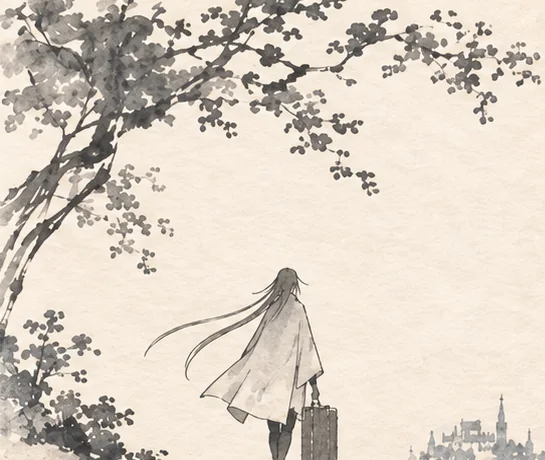
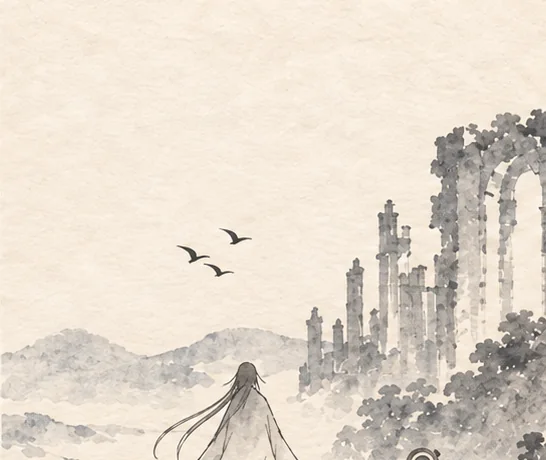
Picture creditsThe three ink-wash illustrations of a traveller were made for this article using an image-generation model. The print at section seven is Tsukioka Kōgyo, Teika, from Nōgaku hyakuban, Art Institute of Chicago, public domain.
More is in JapaneseThe English pages are few and growing slowly. The Japanese site is much larger; until these catch up, a machine translation (Google Translate and the like) opens most of it. Start from the Japanese home.