Benjamin Britten built a church opera from a Noh play about a mother’s grief. It is not an oni story — and that is the point.
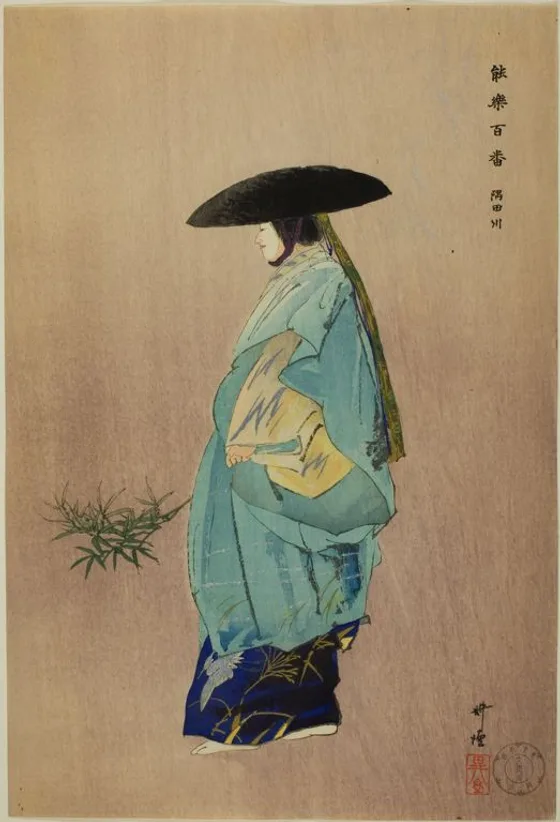
Sumidagawa, from Nōgaku hyakuban, Tsukioka Kōgyo. Art Institute of Chicago (public domain).
1 / 4
The Noh
Sumidagawa is attributed to Kanze Motomasa, a son of Zeami, in the early fifteenth century. A woman has lost her child, Umewakamaru — in the traditional account, taken by a slave trader — and has gone mad with searching. Her wandering carries her east, to the ferry crossing of the Sumida River.
The ferryman tells her of a child who died on the far bank a year ago to the day, and who is mourned there. As he speaks, she understands that the boy was hers. At the grave mound a great nembutsu is raised, and for a moment the child’s voice — and then his figure — appears. She reaches to hold him, and he is gone. The play ends not in a fight but in that vanishing.
2 / 4
What Britten made
Benjamin Britten saw Sumidagawa on a visit to Japan in 1956 — it was his first Noh, and he went back and saw the same play a second time — and it stayed with him for years. The result was Curlew River (1964), the first of his three “Parables for Church Performance,” to a libretto by William Plomer.
Plomer moved the story out of medieval Japan and into the fenlands of medieval East Anglia, by a fictional Curlew River, and reframed it as a Christian mystery play performed by monks. As in Noh, the staging is spare and every role, the Madwoman included, is sung by a man. The slow treatment of time, and the ritual frame, came from what Britten had watched on the Noh stage. Plomer’s cast is the Madwoman, a Ferryman, a Traveller, an Abbot, and the Spirit of the Boy.
What was moved, and what was kept
隅田川 → Curlew River
Sumidagawa · attrib. early 1400sCurlew River · 1964
The searcherA mother gone mad with searching for her lost childThe Madwoman
The one at the crossingThe ferryman at the Sumida crossingThe Ferryman
The childUmewakamaru, dead a year to the day, a voice and then a figure at the grave moundThe Spirit of the Boy
WhereThe ferry crossing of the Sumida River, medieval JapanA fictional Curlew River in the fenlands of medieval East Anglia
Whose rite it isA great nembutsu raised at the grave moundA Christian mystery play performed by monks
What Britten kept from the Noh stage
A spare stage. Every role, the Madwoman included, sung by a man. The slow treatment of time. A ritual frame — a Christian one in place of the nembutsu.
Sumidagawa is attributed to Kanze Motomasa in the early fifteenth century. Britten saw it in Japan in 1956; Curlew River, to a libretto by William Plomer, followed in 1964 as the first of his three Parables for Church Performance. The rows set out what the libretto replaced; the panel below them, what it carried over. The roles are as Faber Music, the publisher of the score, lists them.
3 / 4
The prayer, and the voice inside it
The exchange that interests me most is the one at the grave. In the Noh, the rite is a dai-nenbutsu, a great chanting of 南無阿弥陀仏 — Namu Amida Butsu, the name of Amida Buddha — raised by the mother with a hand-gong and by the people of the far bank. Out of that massed chanting comes a single small voice from inside the mound. The voice arrives first. The figure comes after it.
Britten could not carry the nembutsu into a church in Suffolk, so he replaced the rite and kept the shape of it. Curlew River opens and closes with the monks processing to the Compline hymn Te lucis ante terminum, and that plainsong supplies much of the melodic material of the whole piece. At the height of the lamentation, with the men chanting together, a treble is heard answering them, and the Spirit of the Boy appears above the tomb and speaks to his mother. The Madwoman answers with a long, unwinding Amen.
Put the two side by side and the substitution is exact. A rite sung by many men; one child’s voice coming out of the middle of it, from inside a grave; the mother hearing it before she sees anything. Britten changed the god and kept the acoustics.
A disagreement the play was born with
子方を出すか、出さないか
Zeami and his son Motomasa, the play’s author, are said to have differed over the ending. Zeami held that the dead child should not be shown at all — the vision should live entirely in the mother’s acting. Motomasa wanted a kokata, a child actor, on stage, so that the boy the mother remembers and the dead child in his grave-clothes could be seen against each other. Both stagings have existed from the start; the one you are likely to see is Motomasa’s, and performances without the child are uncommon. Britten, giving the boy a voice and a body above the tomb, took the son’s side.
Our view. Motomasa was right. The father’s version is the more refined idea and the harder craft, and a mother alone on an empty stage, seeing what is not there, is a real piece of theatre. But the play is about the distance between the child she is carrying in her head and the child in the ground, and that distance only becomes visible when both are in front of you. Britten seems to have thought so too.
4 / 4
Why it is not an oni story
Our English feature, Oni are not demons, is about beings the stage makes monstrous. Sumidagawa has none. The mother is a living woman undone by grief; the child is a ghost who only wants to be found, not a vengeful spirit. Nothing here is driven off or subdued.
That is why Britten reached for it. What crossed from Noh to a church in Suffolk was not a demon but a form — restraint, a chorus, a loss held still — and it travelled because the grief underneath needed no translation.
More is in JapaneseThe English pages are few and growing slowly. The Japanese site is much larger; until these catch up, a machine translation (Google Translate and the like) opens most of it. Start from the Japanese home.