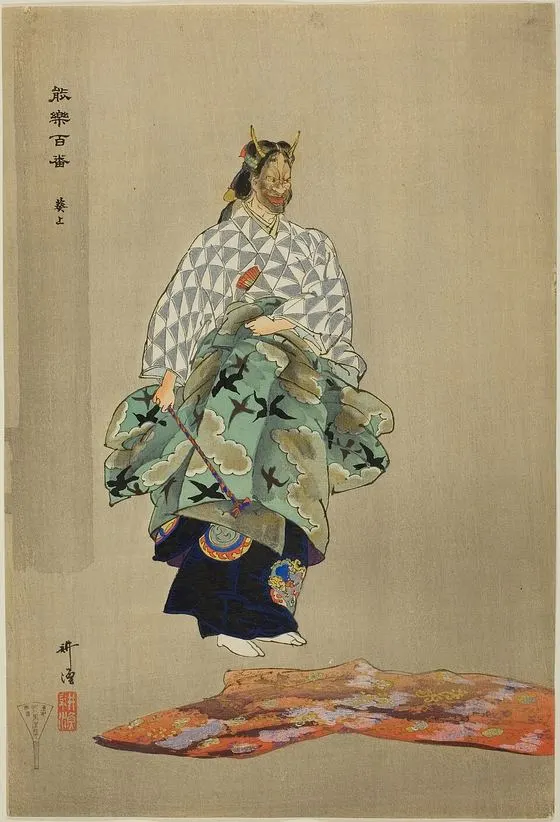
A living woman’s jealousy leaves her and attacks a rival. The sick woman herself never appears — only a folded robe.
1 / 3
The tale
Lady Aoi, wife of Prince Genji, lies gravely ill. On the Noh stage she never appears as a character: a folded kosode robe laid at the front of the stage stands in for her body. A shamaness is called to draw out whatever afflicts her.
The spirit that answers is Lady Rokujō — not a dead ghost but an ikiryō, the living spirit of a woman Genji has turned away from. Her jealousy has left her body while she is still alive. She rides in on a phantom carriage and strikes at the robe.
A mountain ascetic, Yokawa no Kohijiri, is summoned. As he prays, Rokujō’s spirit rises as a horned hannya and fights back. The prayer subdues her, and in that subjugation she is turned toward release.
2 / 3
Two sides of the telling
From its side
The attacker is not a monster from somewhere else. She is a living, high-born woman, and the jealousy is hers before any shape is put on it. The play watches a feeling harden into the hannya — a face a person can be made to wear.
From the human side
Two people face her, and neither kills. The shamaness calls the spirit out; the ascetic prays it down. Where the wife in Kanawa leaves vowing to come back, Rokujō is subdued and, in the prayer, let go. The one she attacks, Aoi, is never more than a robe on the floor.
The question behind this seriesHow does a being with its own logic see us — and who gets to tell its story?
3 / 3
What Noh does with it
Aoi no Ue is the clearest Noh case of an ikiryō, the spirit of someone still living. Its source is the “Aoi” chapter of The Tale of Genji. The play is attributed to Zeami as a reviser, with Konparu Zenchiku named in an older tradition; the authorship is not settled. Staging follows the standard Kanze style.
Compare with
Yukio Mishima reset the play in a modern hospital in his Five Modern Noh Plays (translated by Donald Keene, 1957): Mrs. Rokujō comes by night to the ward where Aoi lies. This is an adaptation, and the reading here is ours — not a claim about the Noh’s own intent.
More is in JapaneseThe English pages are few and growing slowly. The Japanese site is much larger; until these catch up, a machine translation (Google Translate and the like) opens most of it. Start from the Japanese home.